
If you employ people in New York City, there’s a good chance you’re already covered by a mandate you may not have thought much about. The NYC Commuter Benefits Law requires many employers to offer a pre-tax transit benefit. As a result, the rules around who qualifies, when the requirement kicks in, and how much money is involved trip up a lot of businesses.
In this guide, we walk through exactly who must comply, how the employee threshold works, the 2026 contribution limits, and how employer subsidies affect an employee’s tax-free amount. Ultimately, consider it your plain-English reference for staying compliant.
Who Has to Comply With the NYC Commuter Benefits Law
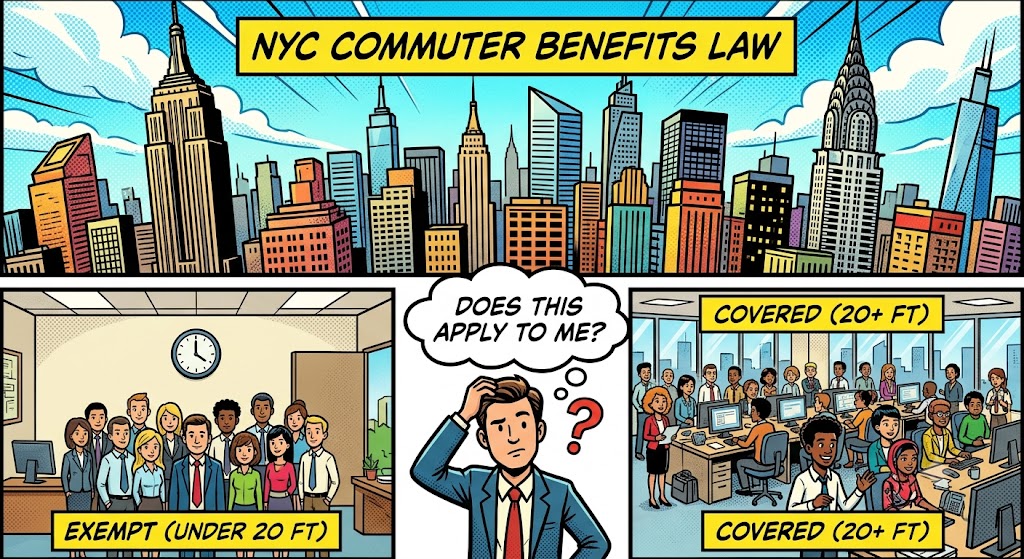
First, there is no statewide New York mandate. However, if you have employees working inside the five boroughs — the Bronx, Brooklyn, Manhattan, Queens, or Staten Island — the city’s rule likely applies to you.
The NYC Commuter Benefits Law covers both for-profit and nonprofit employers with 20 or more full-time, non-union employees working in NYC. Moreover, if you run multiple locations across the city, you count all full-time employees together to see whether you hit the threshold.
A few key definitions:
- Full-time means anyone averaging 30 or more hours per week.
- Part-time employees do not count toward your 20-employee threshold.
- Government employers and workers covered by a collective bargaining agreement generally qualify as exempt — unless you have 20+ other non-CBA employees.
So if you have 15 full-time staff and 10 part-timers, your total headcount is 25. Even so, your qualifying headcount is only 15. As a result, the mandate wouldn’t apply to you yet. Naturally, you’re still free to offer the benefit to part-timers as a perk if you’d like.
If you’re unsure where your group lands, talk to a Waugh Agency specialist. Indeed, we handle compliance questions like this every day for NYC employers.
NYC Commuter Benefits Law: How the 20-Employee Threshold Actually Works
Notably, you don’t have to launch a program the moment you hire your 20th person. Instead, the city uses a rolling three-month average to smooth out normal hiring fluctuations.
Complete our quick form for a free consultation, call (800)779-4090 today, or email service@waughagency.com to get started.
NYC Commuter Benefits Law: The Three-Month Rule
To determine whether you’re covered, first calculate your average number of full-time employees over the most recent consecutive three-month period. Then, once that average hits 20 or more, you’re required to offer the benefit.
New businesses: If you’ve operated in NYC for fewer than three months, you simply average your weekly full-time headcount for the time you’ve been open.
Afterward, once you’re covered, you must give each eligible employee a written offer no later than four weeks after they begin working full-time.
What Happens If Your Headcount Drops
There’s a “grandfather” provision worth knowing. Specifically, if you cross the threshold and later shrink below 20 full-time employees, you must keep offering the benefit to anyone who was already eligible. Consequently, those employees keep it for the rest of their time with you, even if your headcount stays under 20 going forward.
What You’re Required to Offer Under the NYC Commuter Benefits Law
The mandate requires you to let eligible employees use pre-tax income to pay for qualifying commuting costs, up to the federal monthly limit. For reference, the IRS explains the underlying rules for qualified transportation fringe benefits in Publication 15-B.
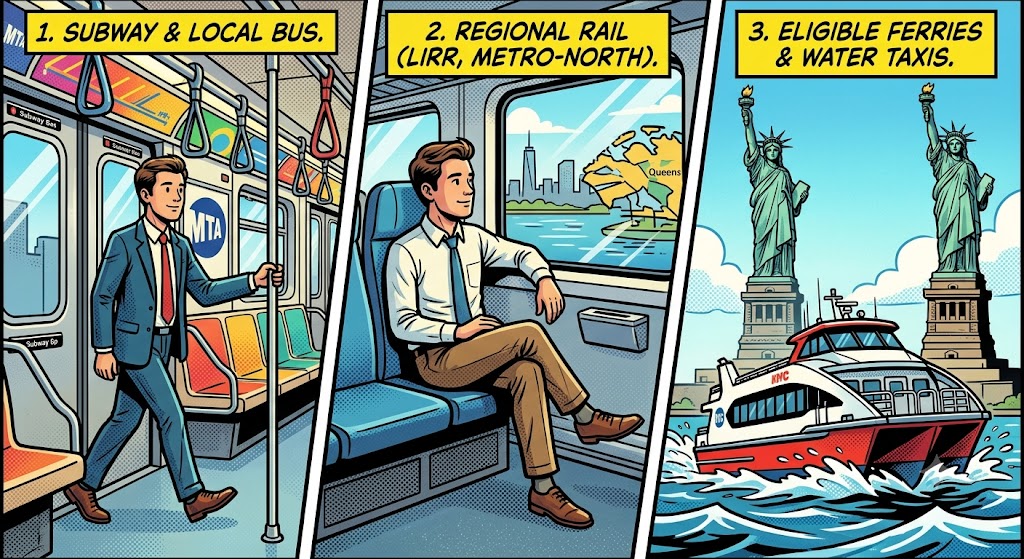
Covered expenses include:
- MTA subways and local buses
- Regional trains (LIRR, Metro-North, NJ Transit, Amtrak)
- Eligible ferries and water taxis
- Commuter vanpools seating at least six adults (not counting the driver)
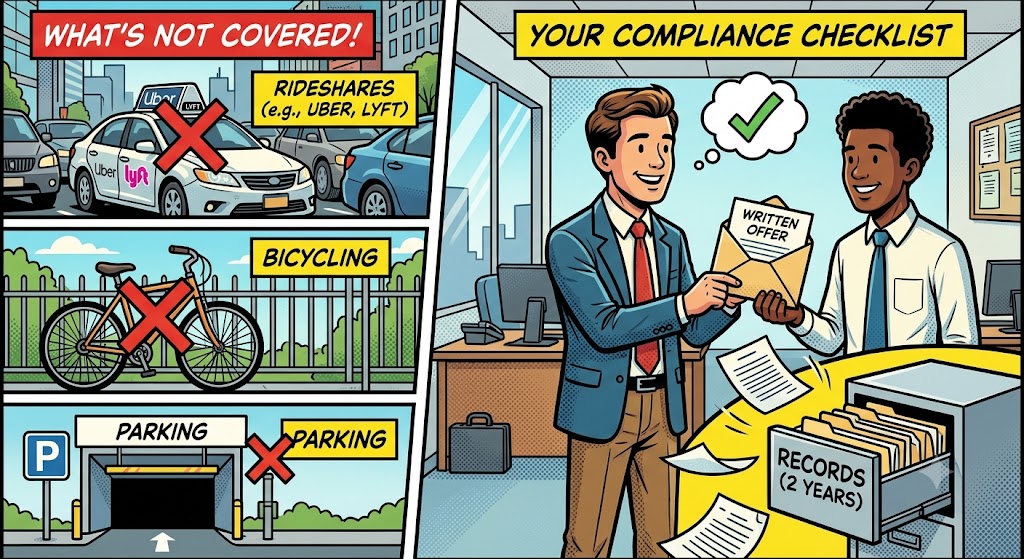
Not covered:
- Parking
- Bicycling
- Rideshares like Uber or Lyft
Complete our quick form for a free consultation, call (800)779-4090 today, or email service@waughagency.com to get started.
Your Compliance Checklist
Ultimately, staying on the right side of the NYC Commuter Benefits Law comes down to a few administrative steps:
- Provide a written offer to every eligible full-time employee.
- Keep records of those offers — and whether each employee accepted or declined — for at least two years.
- Meet the timing rule: you must send the offer by the time an employee completes four weeks of full-time work.
 Because penalties start at $250 and can compound every 30 days, tracking matters. Fortunately, this is exactly the kind of automated compliance tracking we build into our client workflows through the Employee Navigator platform. In short, offers, acceptances, and reporting all live in one place instead of a spreadsheet. Want us to show you how it works? Then schedule a free benefits review.
A Quick History of the Rule
To be clear, the NYC Commuter Benefits Law (Local Law 53) is not new:
- Passed: October 20, 2014
- Took effect: January 1, 2016
- Enforcement began: July 1, 2016, after a six-month grace period
As of 2026, covered NYC employers have offered this benefit for just over a decade.
No Employer Contribution Required
Here’s the part employers appreciate most: you don’t have to put in a single dollar of your own money. The mandate only requires you to facilitate a pre-tax payroll deduction. In practice, employees fund the program entirely using their own wages.
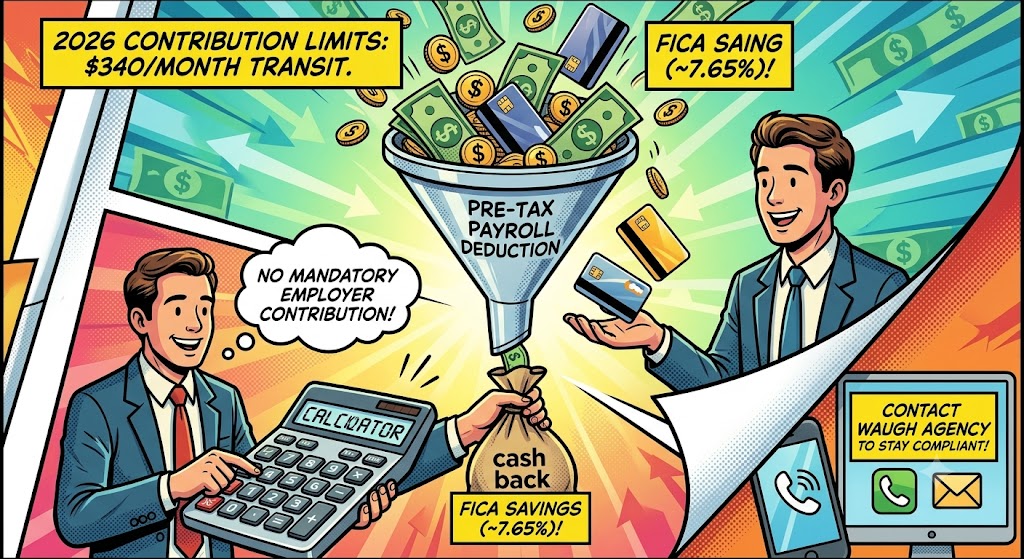
A few financial notes about the NYC Commuter Benefits Law:
- No mandatory subsidies. You don’t have to buy MetroCards or offer stipends.
- You can subsidize if you want to — and those contributions stay tax-deductible for the business.
- Administrative costs exist. Many companies use a third-party administrator (Edenred, WageWorks, Navia) for a small monthly per-participant fee.
- You actually save money. Since employees divert wages pre-tax, your taxable payroll shrinks. Consequently, you skip the roughly 7.65% FICA/Medicare tax on those funds. In turn, those savings often cover or exceed the admin fees.
2026 Contribution Limits
For the 2026 tax year, the IRS raised the monthly pre-tax limits:
- Transit and vanpools: $340 per month (up from $325 in 2025)
- Qualified parking: $340 per month (up from $325 in 2025)
Importantly, these are separate buckets. Therefore, an employee with a hybrid commute — driving to a station, then taking the train — can max both, sheltering up to $680 per month.
Ultimately, complying with this mandate is easier when the paperwork runs itself. Meanwhile, our team keeps NYC and Northeast employers on track while serving clients in all 50 states through trusted affiliates. Call (800) 779-4090 or email service@waughagency.com to have us run the numbers for your group.