
If you run HR or finance for a growing company, you already know the feeling: a benefits compliance question lands in your inbox, and you’re not sure whether it’s a five-minute fix or a five-figure penalty waiting to happen. This guide is built to take that uncertainty off your plate. First, we’ll walk through the core compliance obligations every employer faces in 2026. Next, we’ll add a Massachusetts overlay for our Northeast clients. Finally, we’ll show you how to turn a fragmented, intimidating topic into one simple annual checklist.
No legalese for its own sake. Instead, you’ll get plain English, real deadlines, and a clear path forward.
Why 2026 Compliance Got Harder
Complete our quick form for a free consultation, call (800)779-4090 today, or email service@waughagency.com to get started.
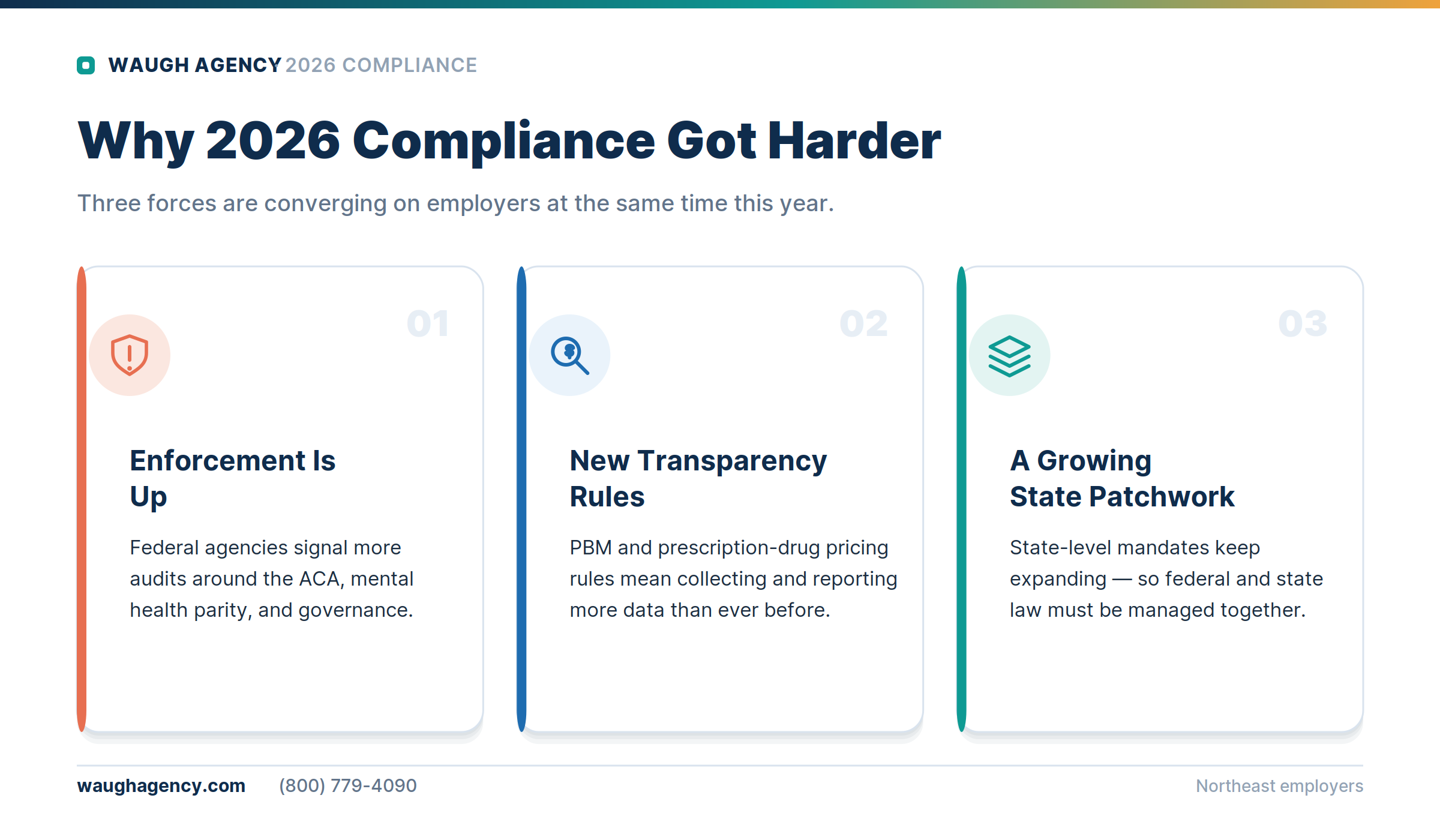
A few things converged to make this year more demanding than the last.
Enforcement is up. Federal agencies have more funding and more appetite to audit health plans. As a result, ACA penalty letters (the dreaded Letter 226-J) keep going out, and mental-health parity reviews have sharpened considerably.
New transparency and PBM rules. Prescription drug cost reporting (RxDC) is now a routine annual obligation, and meanwhile scrutiny of pharmacy benefit managers continues to grow. Consequently, employers are increasingly expected to prove their plans are reasonable and well-managed. For context, the federal government publishes detailed guidance through the U.S. Department of Labor’s Employee Benefits Security Administration.
More moving parts than ever. Between federal mandates and state-specific rules—especially here in Massachusetts—the average employer is juggling a dozen deadlines across the year.
The good news: none of this is unmanageable when it’s organized. Indeed, that’s precisely where a compliance-focused approach makes the difference.
The Core Compliance Obligations, in Plain English
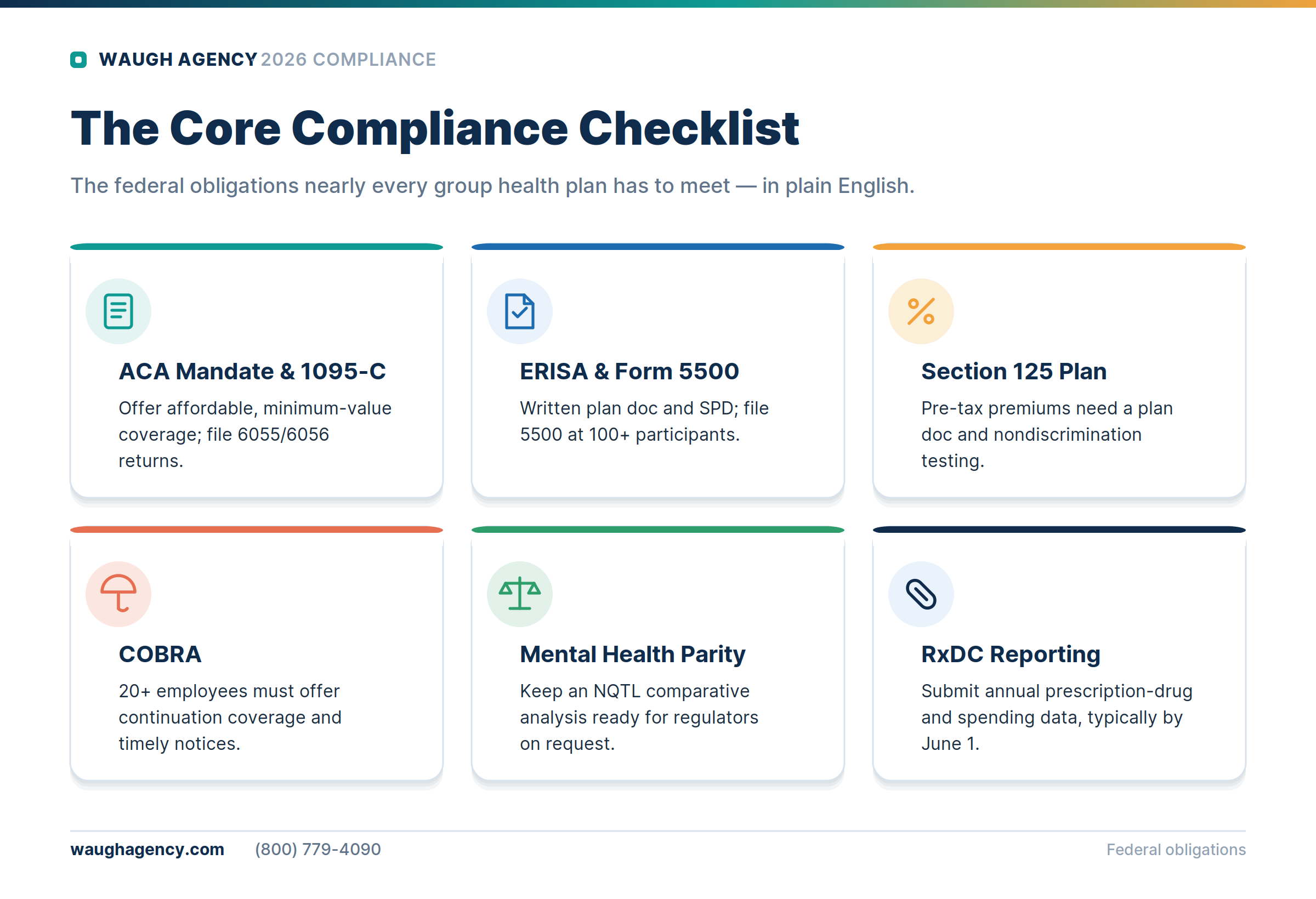
Here are the obligations that apply to most employer-sponsored group health plans. Think of these as the pillars of your annual checklist.
ACA Employer Mandate & 6055/6056 Reporting
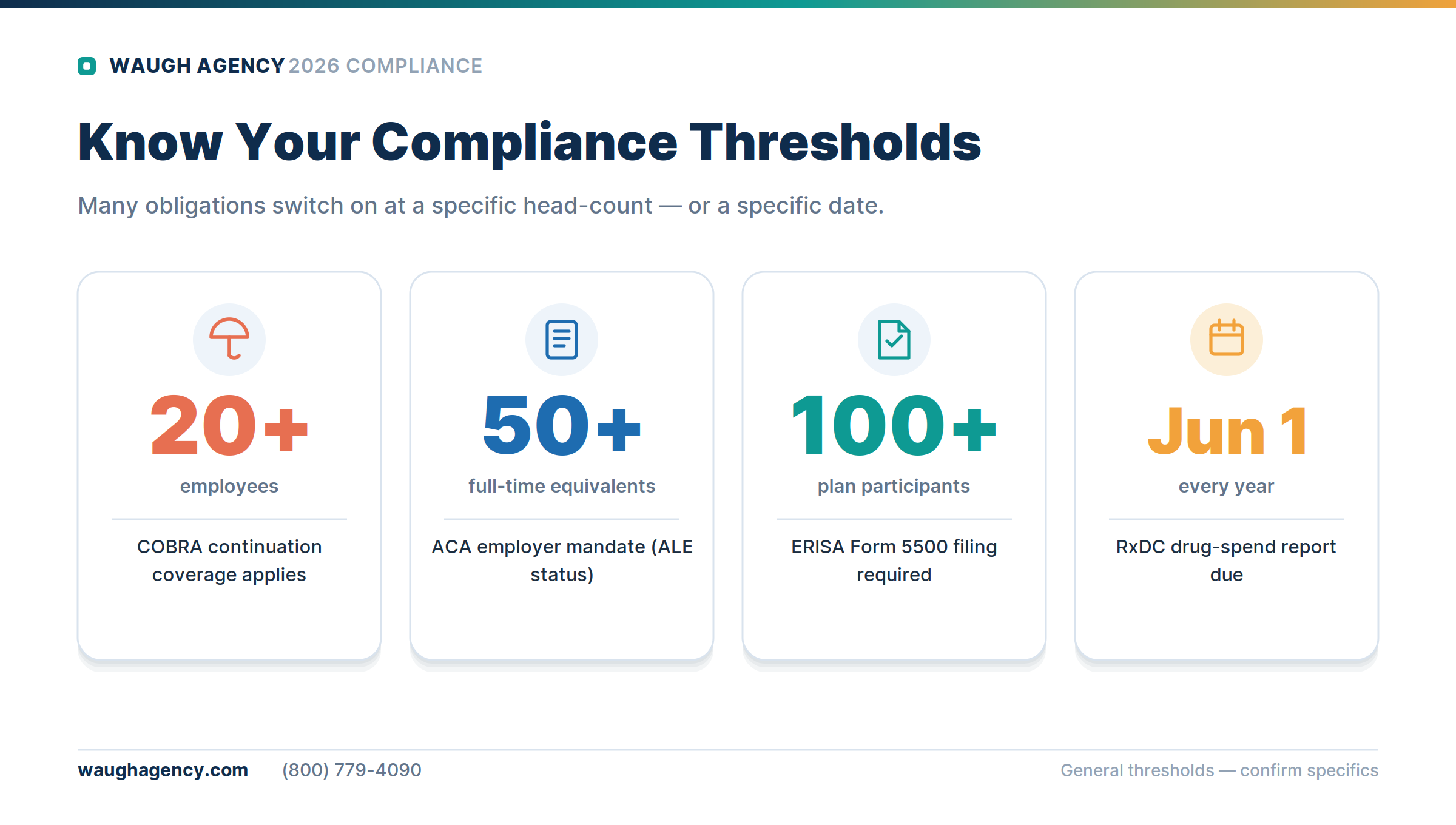
If you’re an Applicable Large Employer (generally 50+ full-time-equivalent employees), the Affordable Care Act requires you to offer affordable, minimum-value coverage to full-time staff—or risk a penalty.
Moreover, you also have to report that you did it. That’s where Forms 1094-C and 1095-C (the 6056 reporting) come in, along with 6055 reporting for self-funded plans. Employees get a 1095-C; meanwhile, the IRS gets the full set.
Miss a deadline or file incorrectly, and penalties stack per form. In fact, this is one of the most common places employers stumble.
Not sure if you qualify for the small-business tax credit while you’re at it? Run your numbers with our Small Business ACA Tax Credit Calculator. Similarly, if you’re building benefits from scratch, our guide to building your first startup health plan is a helpful starting point.
Complete our quick form for a free consultation, call (800)779-4090 today, or email service@waughagency.com to get started.
ERISA Plan Documents & Form 5500
ERISA governs most private-sector benefit plans. Two things, however, trip people up:
- Plan documents and SPDs (Summary Plan Descriptions). You’re required to have a written plan document and to give employees a clear summary. Many employers assume their insurance carrier handles this. Often, however, they don’t—at least not fully.
- Form 5500. Plans with 100+ participants generally must file an annual Form 5500 with the Department of Labor. Furthermore, late filings carry steep daily penalties.
Complete our quick form for a free consultation, call (800)779-4090 today, or email service@waughagency.com to get started.
Section 125 Cafeteria Plans
If your employees pay their share of premiums pre-tax—and most do—you need a written Section 125 cafeteria plan document. Without that document, there’s no legal pre-tax treatment. In short, it’s a small piece of paper that protects a big tax benefit.
COBRA
When an employee leaves or loses hours, COBRA lets them continue group coverage for a set period. Specifically, the compliance burden is in the notices and timing: initial notices, election notices, and specific deadlines. As a result, COBRA administration errors are a frequent source of lawsuits.
Mental Health Parity (NQTL Basics)
The Mental Health Parity and Addiction Equity Act requires that mental health and substance use benefits be treated no more restrictively than medical/surgical benefits. Currently, the hot spot is the NQTL comparative analysis—a written document showing your plan’s non-quantitative treatment limitations (like prior authorization rules) are applied even-handedly.
Regulators are actively requesting these. Therefore, if you don’t have one, you’re exposed.
RxDC Reporting
The Prescription Drug Data Collection (RxDC) report is an annual submission about prescription drug and health care spending. Typically, it requires coordination between you, your carrier or TPA, and your PBM. Because the pieces are scattered across vendors, this is exactly why it gets missed.
If reading that list raised your blood pressure, that’s normal—and fixable. Schedule a free compliance review and we’ll tell you where you stand.
The Massachusetts Compliance Overlay
For our clients across Boston, Worcester, the Cape, the North and South Shore, and Western Mass, federal rules are only half the story. On top of that, Massachusetts layers its own requirements.
MA Paid Family & Medical Leave (PFML). Massachusetts employers must handle PFML contributions, postings, and notices. Because the contribution rates and thresholds adjust periodically, this isn’t a “set it and forget it” item. Moreover, if you offer a private plan, our PFML exemption process page walks through your options. For broader context on how leave rules shape benefits, see our overview of paid family leave laws and employee benefits.
MA Health Connector context. Massachusetts has its own marketplace and a long history of coverage requirements that predate the ACA. Consequently, employers benefit from understanding how state and federal obligations interact—especially around affordability and offering coverage.
State reporting nuances. Massachusetts has had its own employer-level reporting expectations over the years, and the details shift. For that reason, staying current matters.
And if you operate beyond Massachusetts—say, with remote employees in Connecticut, New Hampshire, Maine, or New York, or teams scattered across all 50 states—the complexity multiplies. Fortunately, we serve multi-state employers nationwide, so the rules in every state your people live in get covered, not just your headquarters.
Want us to map your obligations state by state? Ask us to run the numbers for your group, or call (800) 779-4090.
Complete our quick form for a free consultation, call (800)779-4090 today, or email service@waughagency.com to get started.
How Waugh Keeps Clients Ahead
A Free Group Health Compliance Review—Before You Need It
Reading this list, you may already be wondering whether your plan checks every box. That’s exactly the point. Waugh Agency offers a free, no-obligation compliance review that maps your current plan against every federal and state requirement. Better still, it flags gaps before they become penalties. Simply put, it’s the easiest way to replace anxiety with a clear action plan. To see how we approach broader strategy, explore our family office health insurance solutions.
The Massachusetts Overlay: State Rules on Top of Federal
Massachusetts employers carry an extra layer of obligations that federal-only guidance won’t cover.
MA Paid Family & Medical Leave (PFML)
The Commonwealth’s PFML program requires employer contributions, employee deductions, workplace notices, and rate updates that change periodically. Coordinating PFML with your benefits and payroll is a recurring compliance task. Unsurprisingly, it often trips up busy HR teams.
MA Health Connector Context
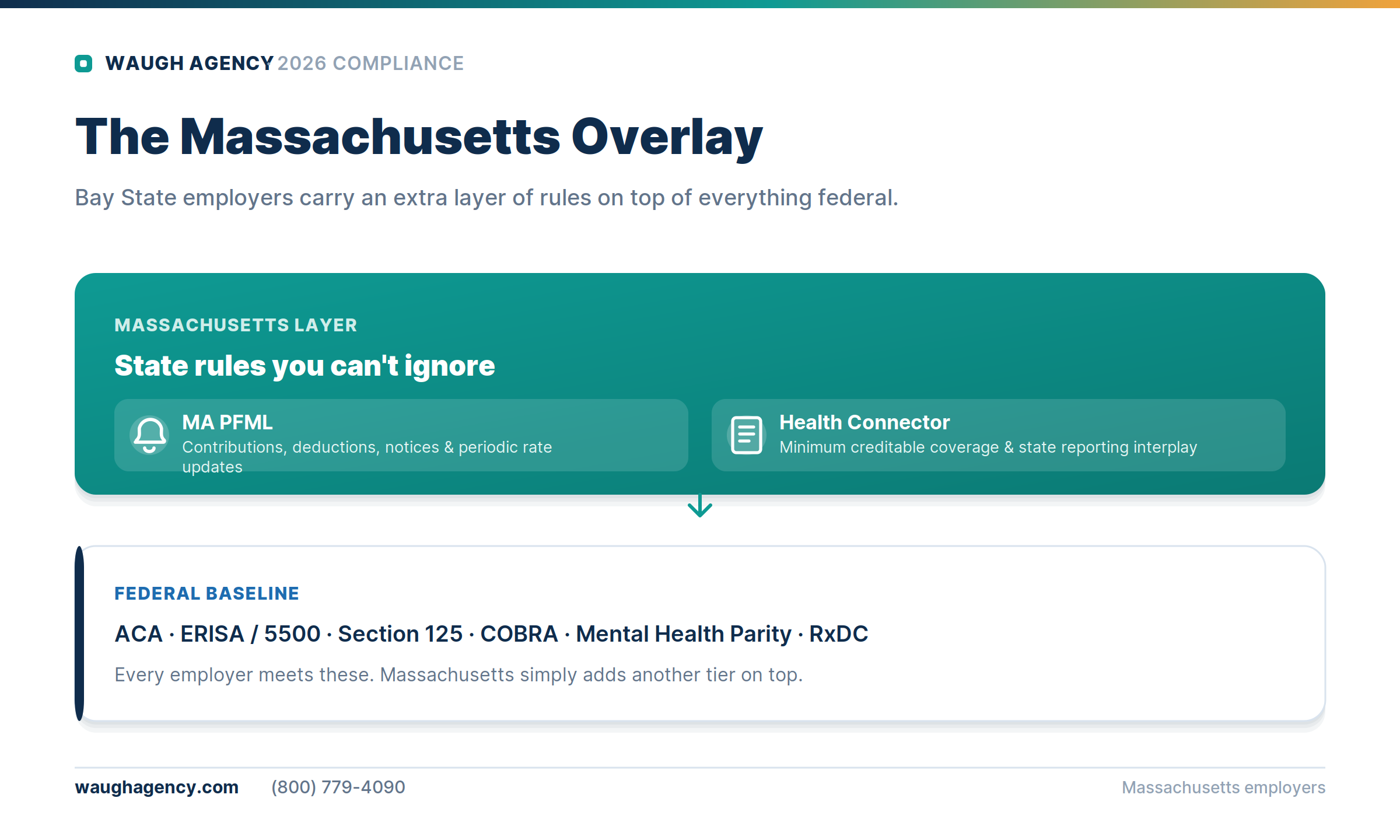
Massachusetts pioneered the individual mandate model, and the Health Connector still shapes the coverage landscape. Consequently, employers must understand how state minimum creditable coverage standards and reporting interact with their group offerings. For small employers weighing carrier options, our overview of the New York State of Health small group exchange offers useful context.
Because so many of our clients operate across state lines, we also handle multi-state employers nationwide. In practice, we track each jurisdiction’s leave laws, reporting rules, and notice requirements. As a result, growing companies don’t get blindsided when they hire in a new state.
How Waugh Keeps Clients Ahead
Compliance isn’t a once-a-year scramble; instead, it’s a system. Here’s how we turn a fragmented topic into a managed process.
Complete our quick form for a free consultation, call (800)779-4090 today, or email service@waughagency.com to get started.
Complete our quick form for a free consultation, call (800)779-4090 today, or email service@waughagency.com to get started.
Automated Deadline Tracking
Every filing, notice, and renewal lives on a tracked calendar. Instead of relying on memory or sticky notes, our clients get proactive alerts well before each due date.
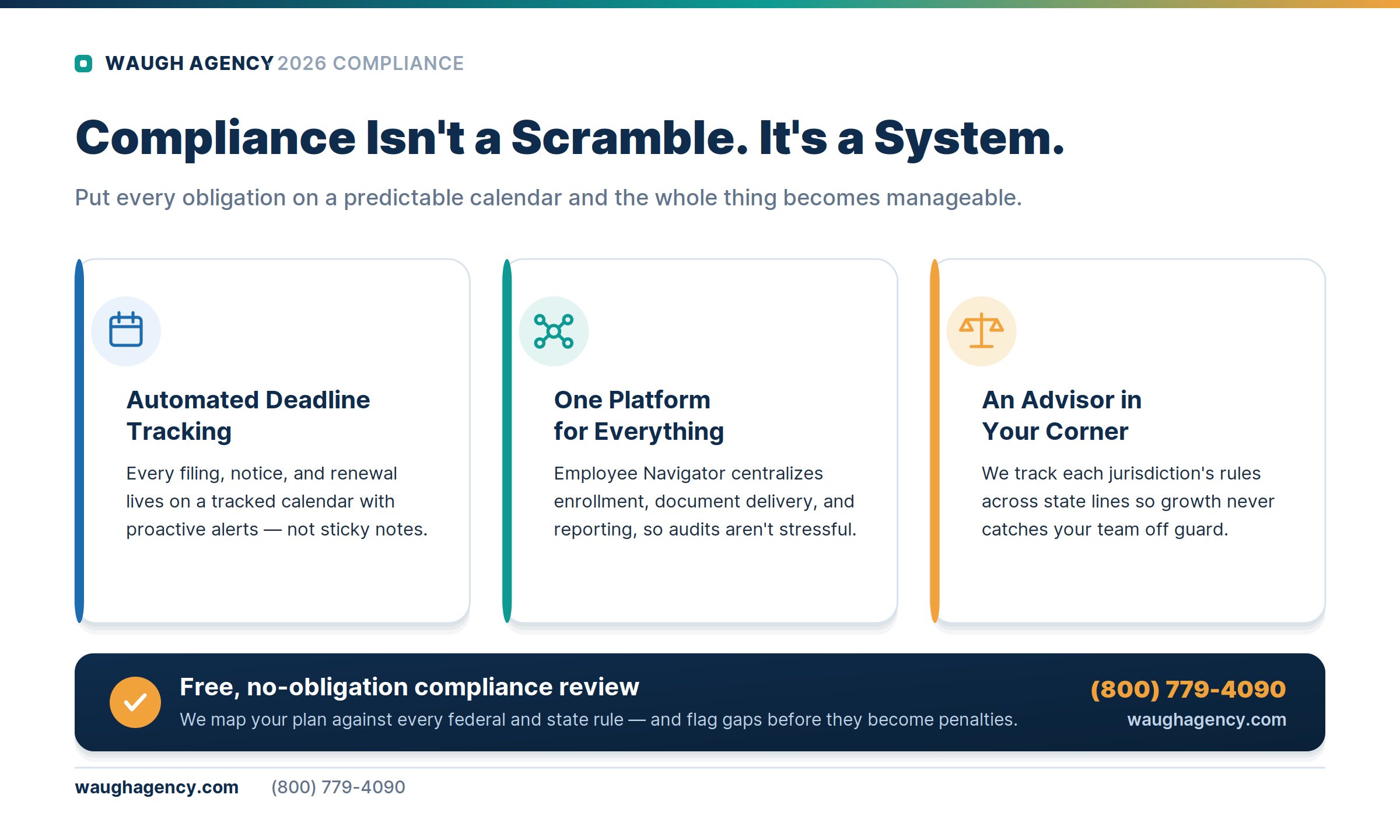
Employee Navigator Platform Reporting
We deploy Employee Navigator to centralize enrollment, document distribution, and reporting. Because everything sits in one place, audits become far less stressful. To learn more about who we are, visit the Waugh Agency team page.