
The HSA last-month rule: one month of coverage, a full year of deposits. The next 13 months decide if you keep them.
The HSA last-month rule lets you deposit the full annual HSA limit, even if your HDHP starts on December 1. This guide shows how the rule works, what breaks it and what a mistake costs.
The HSA last-month rule (also called the full-contribution rule) gives you a full year of deposits for as little as one month of HDHP coverage. It is also easy to get wrong.
People often make two mistakes. They think they need a minimum number of months on the HDHP. They also think a good-faith plan to stay on the HDHP is enough. Both are wrong. The second mistake can cost income tax plus a 10% additional tax.
How the HSA last-month rule works
The standard rule prorates your HSA limit. For each month you are HSA-eligible on the first day, you get 1/12 of the annual limit. If your HDHP starts on December 1, the standard rule gives you one month, or 1/12 of the limit.
The last-month rule replaces that limit. IRS Publication 969 says: if you are HSA-eligible on the first day of the last month of your tax year, you count as eligible for the full year. For almost all taxpayers, that day is December 1. The coverage tier you have on December 1 (self-only or family) applies to the full year.
| Your choice | Prorated limit | Last-month rule |
|---|---|---|
| What you can deposit for 2026 | 1/12 of the limit for each eligible month | The full annual limit, even with one eligible month |
| Testing period | None | Required December 1, 2026 through December 31, 2027 |
| Risk if your coverage changes in 2027 | No look-back on your 2026 deposit | Income tax plus a 10% additional tax on the extra amount |
| Best fit | A job change, Medicare or a plan switch is likely in 2027 | You expect to stay on an HDHP through all of 2027 |
Source: IRS Publication 969.
Two HSA last-month rule mistakes
There is no minimum number of months
You do not need 3, 6 or 9 months on the HDHP. You only need to be HSA-eligible on December 1. If your HDHP starts on December 1, one month of coverage lets you deposit the full annual limit.
Intent to stay is not enough
A good-faith plan to keep the HDHP does not protect you. The rule has a mandatory testing period. You must stay HSA-eligible for all 13 months.
A bigger deposit now, for a 13-month promise that the IRS enforces.
How the 13-month testing period works
The testing period starts on the first day of the last month of your tax year. It ends on the last day of the 12th month after that month. For a 2026 deposit, the testing period is December 1, 2026 through December 31, 2027.
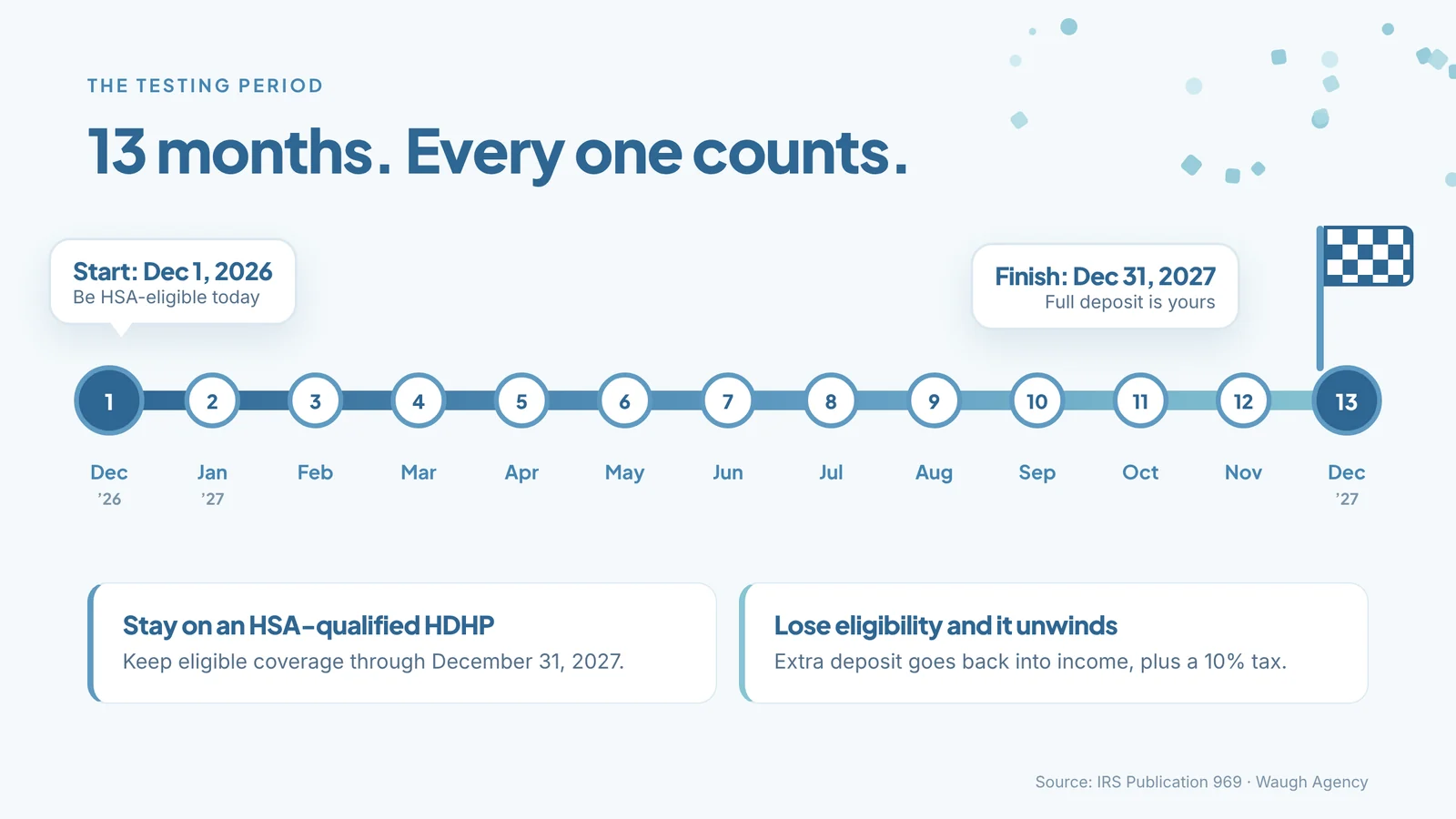
Be eligible on December 1
On December 1, 2026, have HDHP coverage and no disqualifying coverage.
Deposit the full limit
Deposit up to $4,400 (self-only) or $8,750 (family) for 2026. If you are 55 or older, add $1,000. The deadline is the April 2027 tax filing date.
Stay eligible through 2027
Keep HDHP coverage and stay HSA-eligible every month through December 31, 2027.
What breaks the test
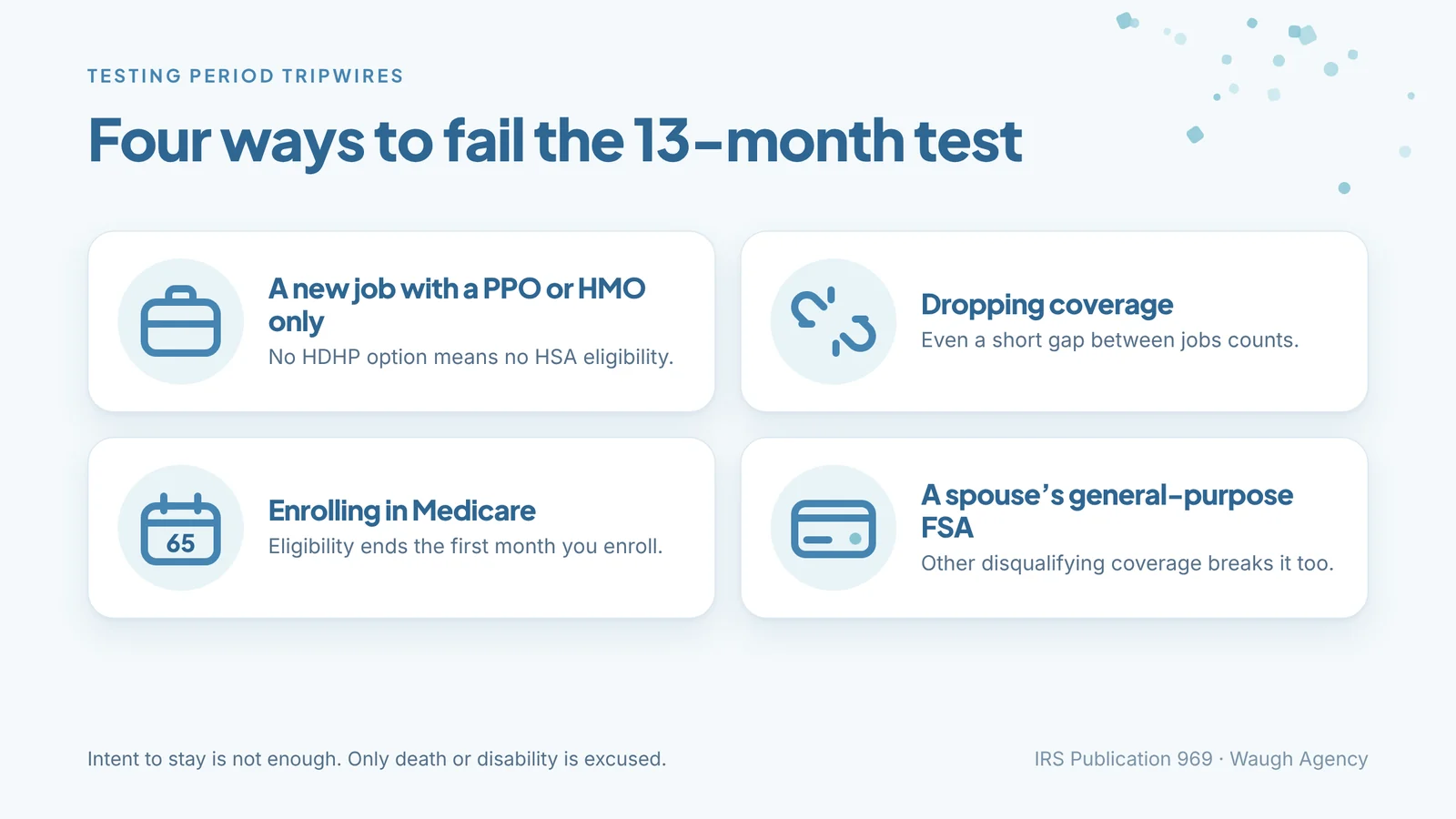
- A new job that offers only a PPO or HMO, with no HDHP
- A gap in HDHP coverage, even a short gap between jobs
- Medicare enrollment: HSA eligibility stops in the first month of Medicare enrollment
- Other disqualifying coverage, for example a spouse’s general-purpose health FSA
There are only two exceptions: death and disability. If you lose eligibility for one of these reasons, you owe nothing. A job change, a plan change or Medicare is not an exception.
What failing the test costs
If you fail the testing period, two costs apply in the year that you lose eligibility. You report both on Form 8889.
- Income tax recapture. The extra amount (all deposits above your prorated limit) goes back into your gross income.
- A 10% additional tax. The IRS adds a 10% tax on the same extra amount, on top of the income tax.
HSA last-month rule example: a July job change
You enroll in an HDHP on November 15, and coverage starts December 1, 2026. The standard rule limits you to 1/12 of the 2026 limit. With the last-month rule, you deposit the full limit. Your testing period is December 1, 2026 through December 31, 2027.
In July 2027 you take a new job and change to a PPO. You fail the test. The deposits for the other 11 months go into your 2027 taxable income. You also owe the 10% additional tax.
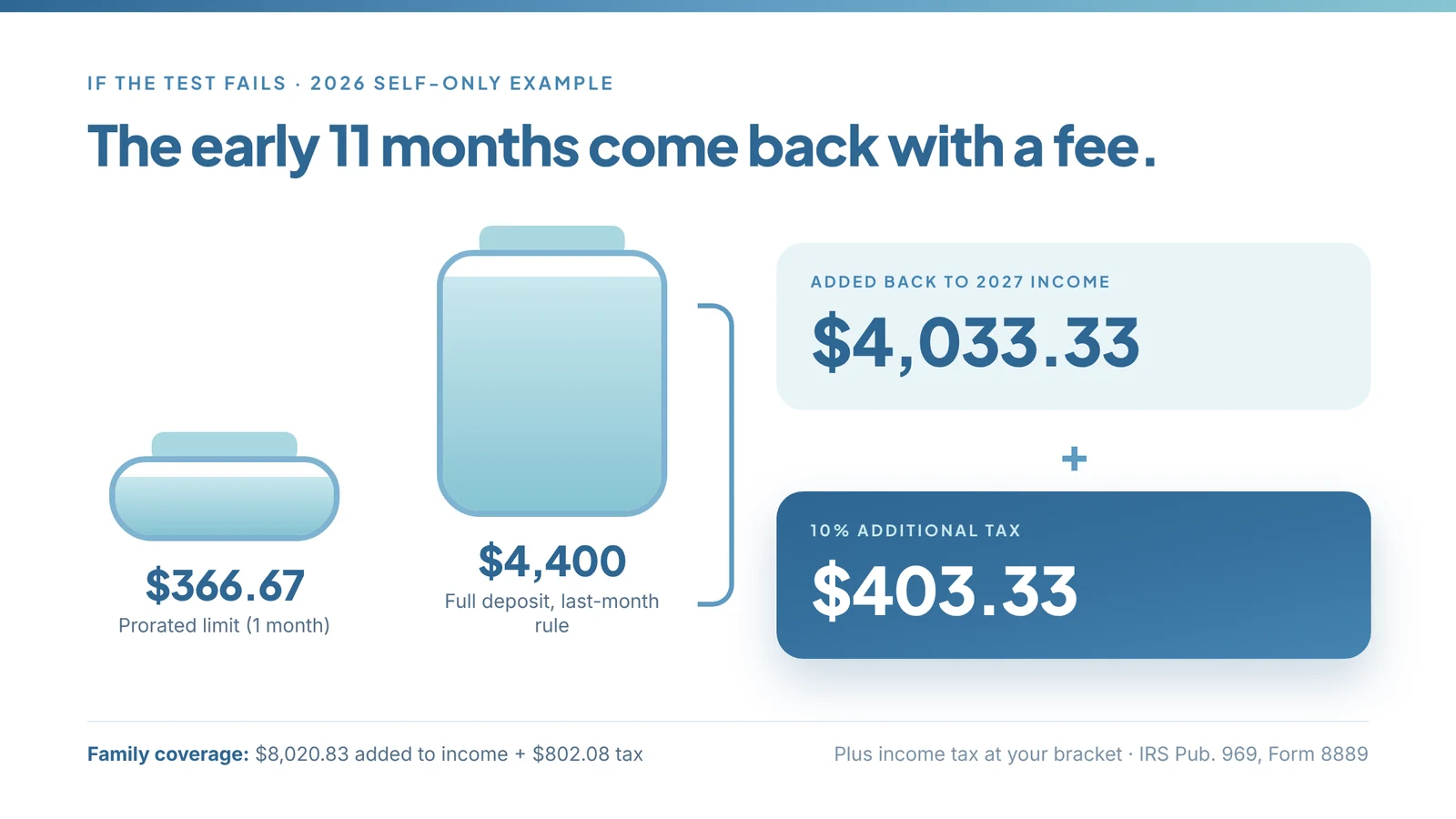
| 2026 contribution | Self-only | Family |
|---|---|---|
| Full limit deposited under the last-month rule | $4,400.00 | $8,750.00 |
| Prorated limit (1 month of 12) | $366.67 | $729.17 |
| Extra amount added to 2027 income | $4,033.33 | $8,020.83 |
| 10% additional tax | $403.33 | $802.08 |
| Federal income tax at a 22% bracket, for illustration | $887.33 | $1,764.58 |
| Total federal cost of failing the test | $1,290.66 | $2,566.66 |
Figures use the 2026 limits from IRS Rev. Proc. 2025-19 and exclude the age-55 catch-up and state income tax.
You can remove an excess HSA deposit by your filing deadline and avoid the 6% excise tax. A failed testing period has no fix of this type. If you deposit under the HSA last-month rule and then lose eligibility, the income tax and the 10% additional tax apply.
The HSA last-month rule for employers
Under the HSA last-month rule, the employee is responsible for the testing period. The employer and the HSA custodian do not track it or report a failure. A short note at the right time protects your team from a tax bill they did not expect.
Fall and December 1 new hires
Tell them that they can deposit the full limit, with a 13-month commitment. For an employee who is not sure about 2027, the prorated limit is the safe choice.
Employees who leave in 2027
Give them a short exit note. If they used the HSA last-month rule for 2026, a move to a plan that is not an HDHP before December 31, 2027 causes the recapture.
Employees turning 65
Medicare enrollment stops HSA eligibility. If an employee plans to enroll during the testing period, the prorated limit is the safer choice.
Front-loaded employer money
Employer HSA deposits count toward the same annual limit. Plan the deposit schedule so that new hires stay under the limit.
HSA limits for 2027
For 2027, IRS Rev. Proc. 2026-24 raises the HSA limit to $4,500 for self-only coverage and $9,000 for family coverage. The age-55 catch-up stays at $1,000. An HSA-qualified HDHP needs a deductible of at least $1,750 (self-only) or $3,500 (family) in 2027.
How Waugh Agency helps
We build HSA programs that employees understand and use. Waugh Agency is a team of group health and health-reform compliance specialists: NABIP Accredited and multi-state licensed. We work from Andover, Massachusetts, with employers across Boston, New York City and the Northeast, and in all 50 states through trusted affiliates.
HDHP plan design
We make sure each plan meets the IRS HDHP limits for the plan year, so every enrolled employee stays HSA-eligible.
Clear employee communication
We give your team plain-language guidance on the last-month rule, proration and the testing period at enrollment.
Enrollment runs on Employee Navigator, at no cost to eligible groups. We absorb the subscription. You get AI-assisted plan build, 600+ carrier, payroll and TPA integrations, and automated compliance tracking.
Make your HSA plan work for every hire.
Book a 15-minute call this week. We review three items with you: your HDHP design, your employer HSA deposits and your new-hire message about the HSA last-month rule.
service@waughagency.com · Mon–Fri 8:30a–7:00p · Sat 10:00a–4:00p
Tell us about your group. We will reach out with two times for your review.
General information only — not legal, tax, or insurance advice for a specific situation. Talk with your tax advisor about how the last-month rule applies to your own return.