
On July 22, 2026, the U.S. Senate Health, Education, Labor and Pensions (HELP) Committee advanced eleven bipartisan healthcare bills in a single markup. In short, the July 2026 healthcare bills could quietly reshape your next group plan renewal. Indeed, most headlines focused on the Patients Deserve Price Tags Act and its promise of roughly $1,000 in annual family savings. For a Boston software firm with 40 employees, a Worcester manufacturer at 90, or a Manhattan agency at 115, however, the more useful question is simple: which of these bills actually changes your renewal — and what should you do about it now?
For another helpful perspective, this July 2026 Healthcare Bills highlights practical trade-offs for buyers. Below, we sort the eleven bills by real-world impact on small-group employer plans in the 25–125 employee range, with a Northeast lens. First, though, one caveat: this is general educational information, not legal, tax, or insurance advice for a specific plan or employer.
July 2026 Healthcare Bills: Why This Package Matters More to Small Employers Than Big Ones
For another helpful perspective, this July 2026 Healthcare Bills highlights practical trade-offs for buyers. Large employers have benefits teams, in-house counsel, and pharmacy analysts. Small and mid-sized employers, on the other hand, don’t. Yet they’re absorbing the same double-digit rate pressure. For example, Massachusetts’ Division of Insurance approved 2026 small-group rate increases averaging 11–13%. Those increases were driven largely by rising drug spend and higher-cost care settings. That’s the backdrop.
For another helpful perspective, this July 2026 Healthcare Bills highlights practical trade-offs for buyers. Broadly speaking, the eleven bills fall into four buckets for a 25–125 employee group: price transparency, prescription drug cost and safety, healthcare workforce, and public health and prevention. Notably, the first two carry most of the near-term dollar impact.
Want the short version for your group? Call (800) 779-4090 or email service@waughagency.com. We’ll flag which of these matter for your renewal.
July 2026 Healthcare Bills: Price Transparency — The Biggest Near-Term Lever
July 2026 Healthcare Bills: Patients Deserve Price Tags Act (S. 2355)
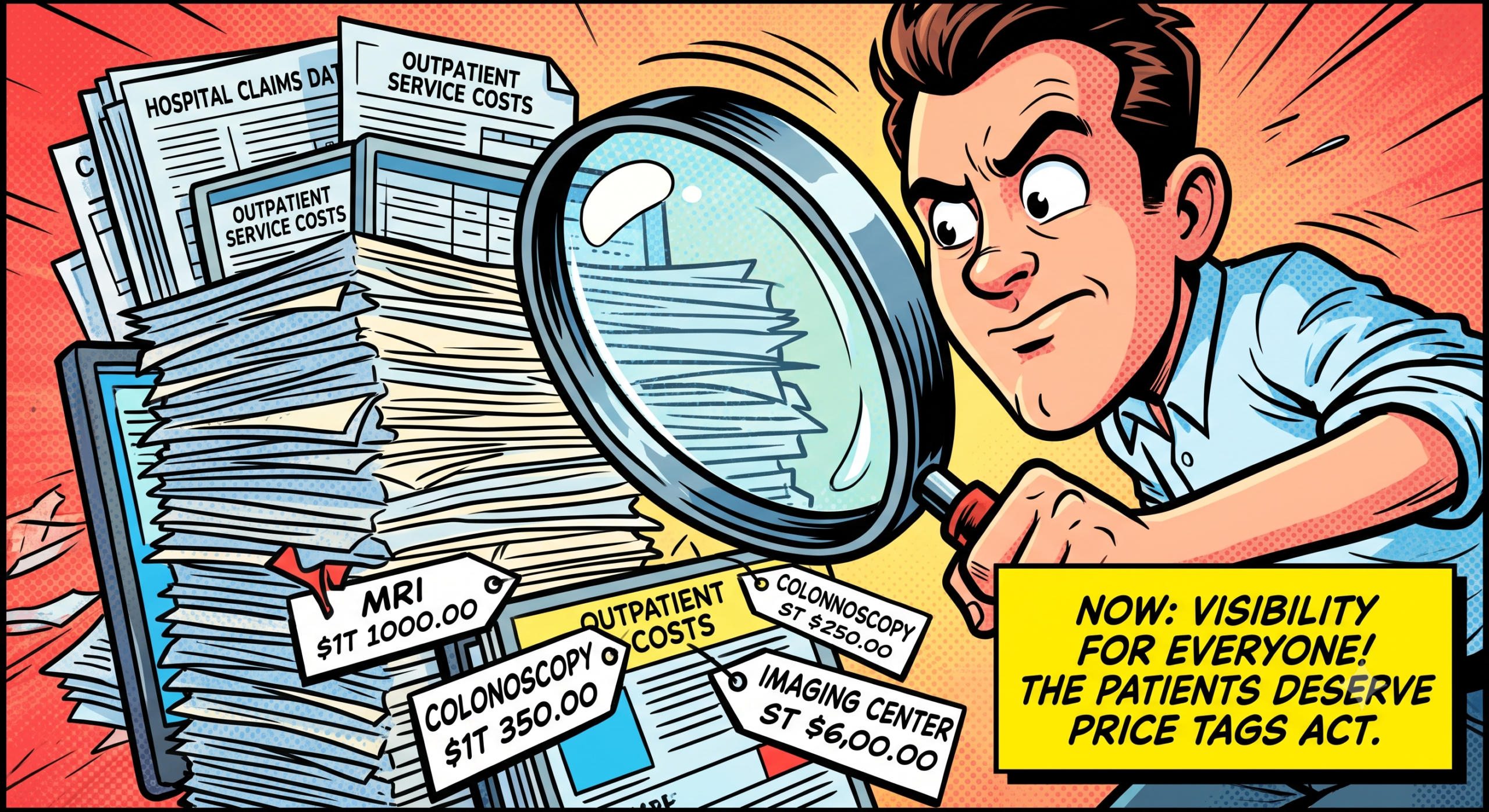
This is the bill small employers should watch closest. Specifically, it codifies and expands hospital price transparency rules and extends them to ambulatory surgery centers, imaging centers, and clinical labs. For employers, moreover, it strengthens plan sponsors’ ability to analyze their own claims data. That visibility, until recently, only jumbo employers had.
Consider a 60-person employer in Cambridge or Stamford. If this passes, then brokers can run true site-of-service comparisons for MRIs, colonoscopies, and outpatient surgery. These categories quietly drive plan cost. As a result, steering even 20% of imaging spend from a hospital-based site to a freestanding facility can meaningfully bend a renewal.
Moreover, the bill reinforces the fiduciary responsibilities employer plan sponsors already carry under the Consolidated Appropriations Act. Academic medical centers, meanwhile, have raised operational concerns, so expect phased implementation.
How Waugh helps: we already build claims-data reviews and site-of-service analyses into our group health service for fully-insured, level-funded, and self-funded clients. If you’d like, learn more about our approach and ask us to run the numbers for your group.
Complete our quick form for a free consultation, call (800)779-4090 today, or email service@waughagency.com to get started.
Prescription Drug Cost and Safety
Specialty and brand-name drugs are the single fastest-growing line item on most small-group plans. In fact, four of the eleven bills touch this directly.
INSULIN Act of 2026 (S. 4189)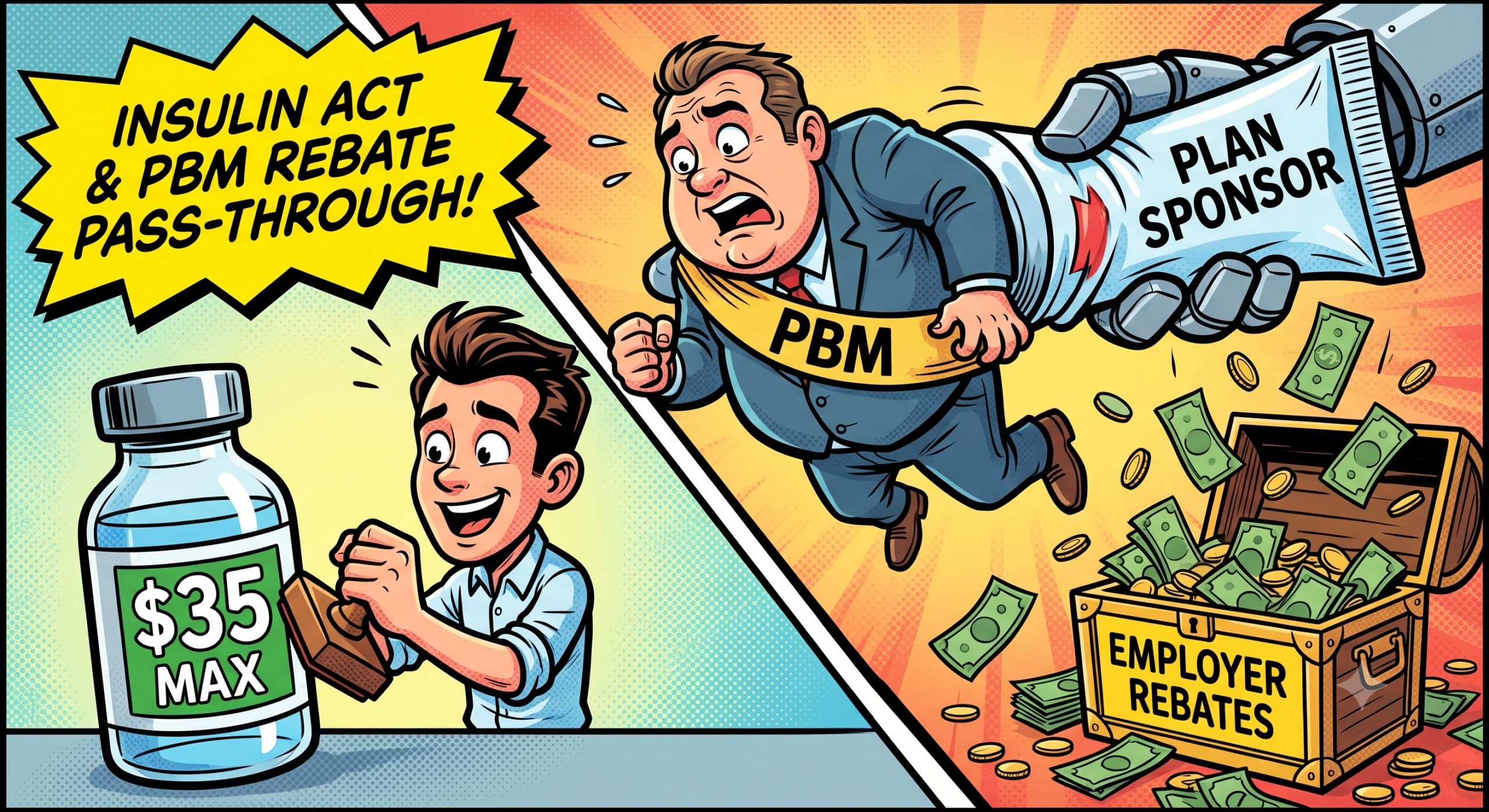
This bill caps insulin cost-sharing at $35 per month for a 30-day supply on commercial plans. The cap starts in plan year 2027, with no deductible allowed on selected insulin products. Then, in 2028, patients pay the lesser of $35 or 25% of net price. Additionally, Pharmacy Benefit Managers (PBMs) must pass through 100% of insulin rebates to plan sponsors.
For an employer with even a handful of diabetic employees, this is meaningful. Specifically, you get better adherence and fewer emergency visits. Furthermore, if the rebate pass-through works as intended, expect a small but real premium impact over time. Importantly, the compliance lift falls on the carrier and PBM, not on you.
Expedited Access to Biosimilars Act (S. 1414)
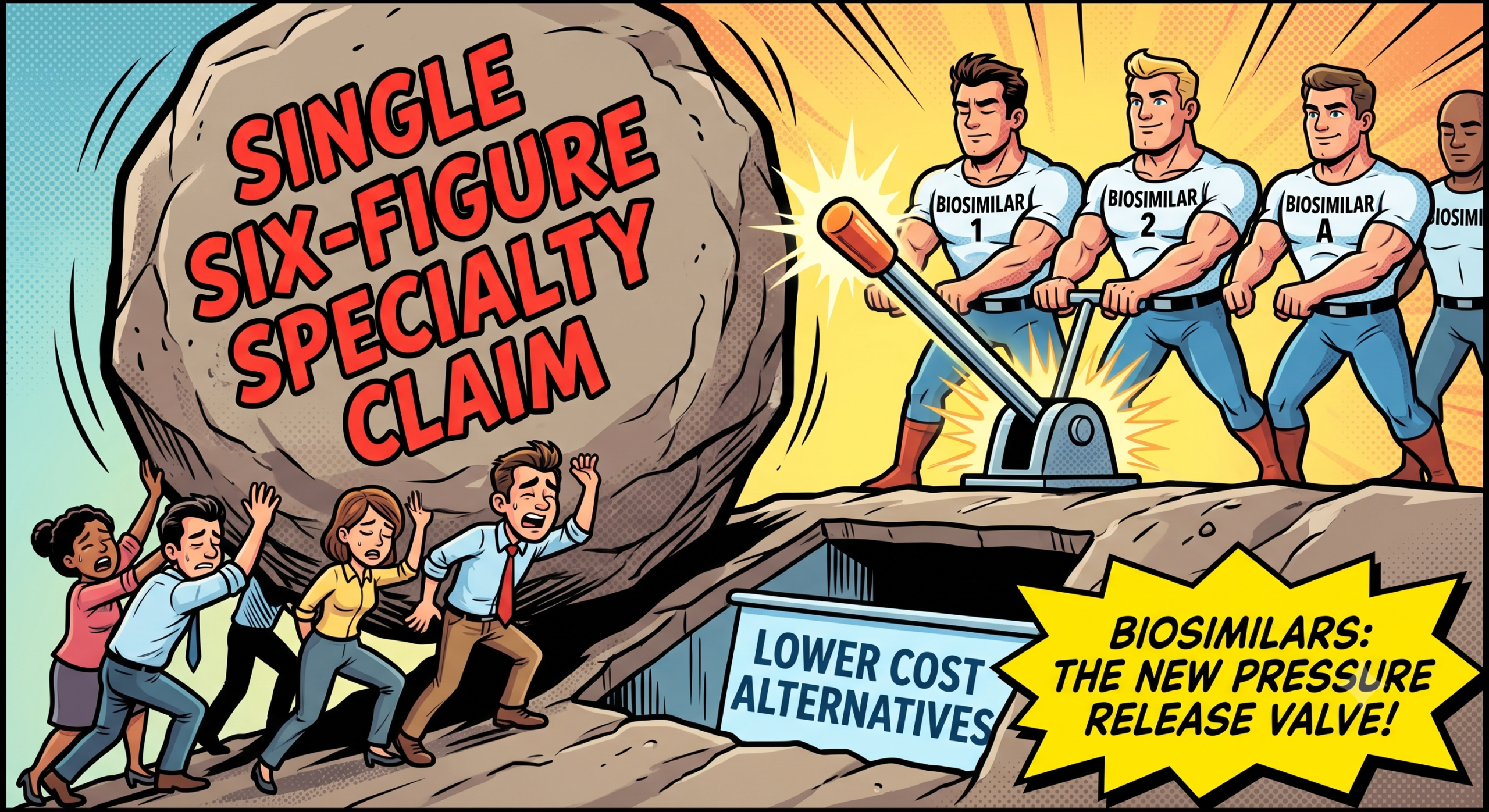
This one is quiet but consequential. Essentially, it modernizes the FDA’s biosimilar approval process to bring lower-cost alternatives to expensive biologics to market faster. Think arthritis, autoimmune, and oncology drugs. Meanwhile, a single six-figure specialty claim can move a small group’s renewal by several points. Therefore, more biosimilar competition is exactly the pressure release small-group premiums need.
Complete our quick form for a free consultation, call (800)779-4090 today, or email service@waughagency.com to get started.
CLEAR LABELS Act (S. 3788)
This bill requires prescription drug labels to identify country of origin for both the finished drug and its active ingredients. Admittedly, it has little direct cost impact. Still, it is a step toward supply-chain resilience — which matters whenever a shortage forces employees onto more expensive alternatives.
SAFE Drugs Act of 2026 (S. 3794)
This measure tightens FDA authority over mass-compounded drugs, with GLP-1 weight-loss compounds explicitly in the crosshairs. If your plan or employees rely on compounded semaglutide or tirzepatide from large-scale compounders, then expect that supply to narrow. Therefore, for employers weighing GLP-1 coverage in 2026 or 2027, this reinforces the case for structured, formulary-based coverage over open-ended reimbursement.
Schedule a free benefits review if GLP-1s are on your radar. Just call (800) 779-4090.
What the Healthcare Bills Mean for the Workforce
EMPOWER for Health Act (S. 4110)
This act reauthorizes HRSA’s Title VII health professions programs through FY2030. In addition, it includes loan repayment for clinicians in pediatrics, primary care, geriatrics, and dentistry. Small-group employers don’t feel workforce policy in their renewal directly. However, they do feel it in network adequacy. In practice, that means whether the pediatrician near a Newton employee is still taking patients, or whether a Hartford mental-health provider has a six-month waitlist.
Title VIII Nursing Workforce Reauthorization Act of 2025 (S. 1874)
This bill reauthorizes nursing education programs and expands eligible uses to include simulation, telehealth, and virtual clinical training. Notably, Northeast nursing shortages are a top driver of hospital labor costs. In turn, hospital labor flows through to your premium.
Together, these are the “eat your vegetables” of the package: structural, not flashy. Even so, they help keep care accessible in Boston, Providence, New Haven, and every mid-sized Northeast city where hiring is already tight.
Public Health, Safety, and Prevention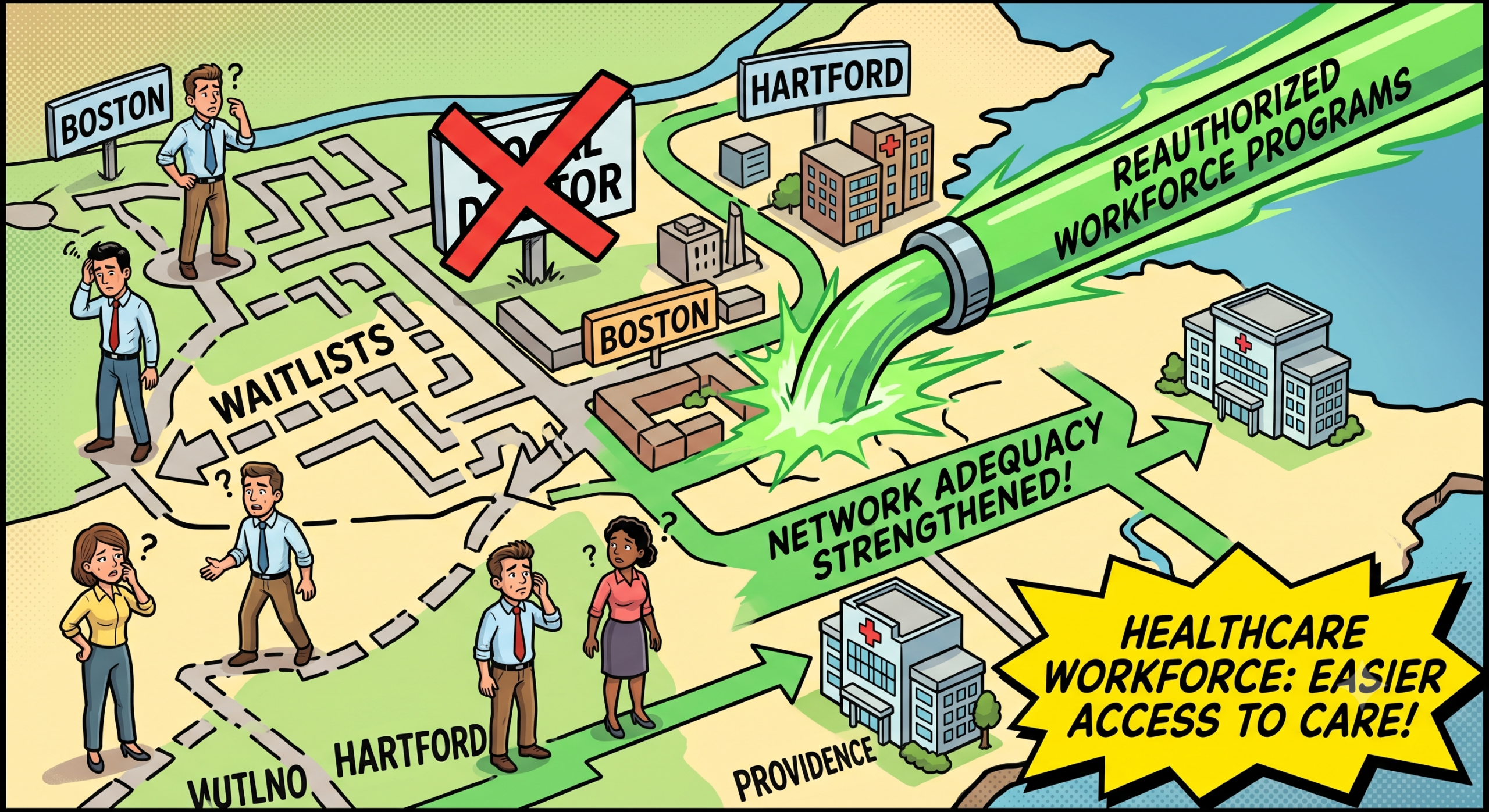
Four bills sit here. They matter, but they don’t rewrite a 2027 renewal.
- Making America’s Food Safer Act (S. 4974) — gives FDA authority to destroy dangerous imported food and expands information sharing with state and local authorities.
- Childhood Diabetes Reduction Act (S. 5026) — adds front-of-package warning labels on ultra-processed foods and beverages high in added sugar, plus restrictions on child-directed junk food ads. This is a long-horizon prevention play.
- National Plan for Epilepsy Act (S. 494) — creates a federal coordinating plan and advisory council through 2035. It’s meaningful for affected families, though there’s no direct employer plan lift.
- Rural Obstetrics Readiness Act (S. 380) — funds HRSA grants for emergency obstetric training and rural telehealth. It has limited impact for most Boston, NYC, or Hartford-area employers. Instead, it matters more for Western Mass, Northern New England, or upstate NY clients with rural workforces.
The Northeast Angle: Why These Healthcare Bills Land Harder Here
Massachusetts, Connecticut, and New York run some of the most tightly regulated small-group markets in the country. For instance, Massachusetts merges its individual and small-group risk pools, and 2026 approved rate increases came in around 11–13%.
Consequently, any federal transparency, drug-pricing, or workforce bill that trims underlying medical trend gets amplified through markets like these. Carriers here simply have less room to hide cost drivers behind loose regulation. If both the Patients Deserve Price Tags Act and the biosimilar bill become law, then a well-advised 25–125 employee Northeast employer should see a compounding benefit over the next two to three renewal cycles.
How Waugh Agency Turns These Bills Into Renewal Strategy
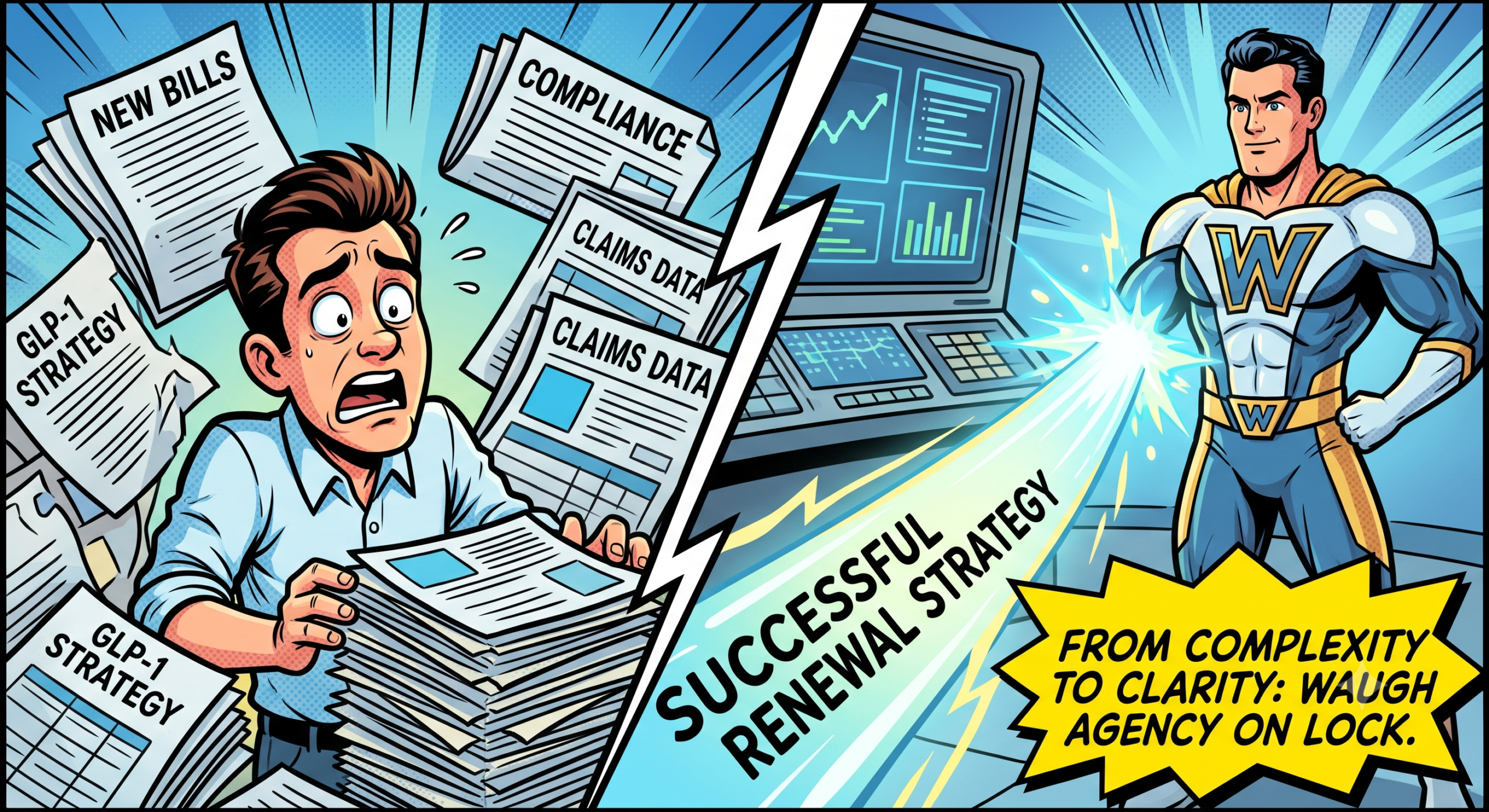 New laws only help if someone in your corner is actually reading them. For 25–125 employee groups, that looks like:
- Claims and site-of-service analysis as new transparency data becomes available.
- Formulary and PBM review — including insulin rebate pass-through, biosimilar substitution, and GLP-1 coverage strategy under the SAFE Drugs Act.
- Compliance tracking — federal transparency, ACA, and CAA fiduciary requirements handled inside the Employee Navigator platform, which we provide at no cost to eligible client groups.
- Modern administration — automated online enrollment, AI-assisted plan building, and 600+ carrier, payroll, and TPA integrations.
In 2026, additionally, we’re transitioning all clients from Ease to the newer Employee Navigator portal, since Employee Navigator acquired Ease in 2023. Whether you’re a 30-person startup in the Seaport, a 90-person firm in White Plains, or a 120-employee manufacturer in Central Massachusetts, we can model how these bills will hit your plan. Through our national affiliate network, moreover, we also support clients in all 50 states.
Bottom Line
Complete our quick form for a free consultation, call (800)779-4090 today, or email service@waughagency.com to get started.
Eleven bills advanced. Ultimately, two or three will meaningfully move small-group employer economics if they clear both chambers: price transparency, insulin cost caps with PBM rebate pass-through, and biosimilar acceleration. The rest, meanwhile, are worth knowing about, but not worth losing sleep over.
The best time to prepare for your 2027 renewal is now. Specifically, act before the transparency data lands, before the insulin cap kicks in, and before the next specialty-drug launches hit your plan.
Talk to a Waugh Agency specialist. Call (800) 779-4090 or email service@waughagency.com to schedule a free benefits review. Then we’ll walk you through what these bills mean for your specific group — no policy expertise required.