BCBSMA Drops Small-Group National PPO/EPO Plans: What Multi-State Employers Should Do Now
If your company has employees spread across more than one state, a recent decision from Blue Cross Blue Shield of Massachusetts may force a rethink of your entire benefits strategy. Here’s what’s happening, why it matters, and how a modern self funded health plan can fill the gap — potentially at a lower cost than the coverage you’re losing.
The Change: BCBSMA Pulls National PPO and EPO Plans for Small Groups
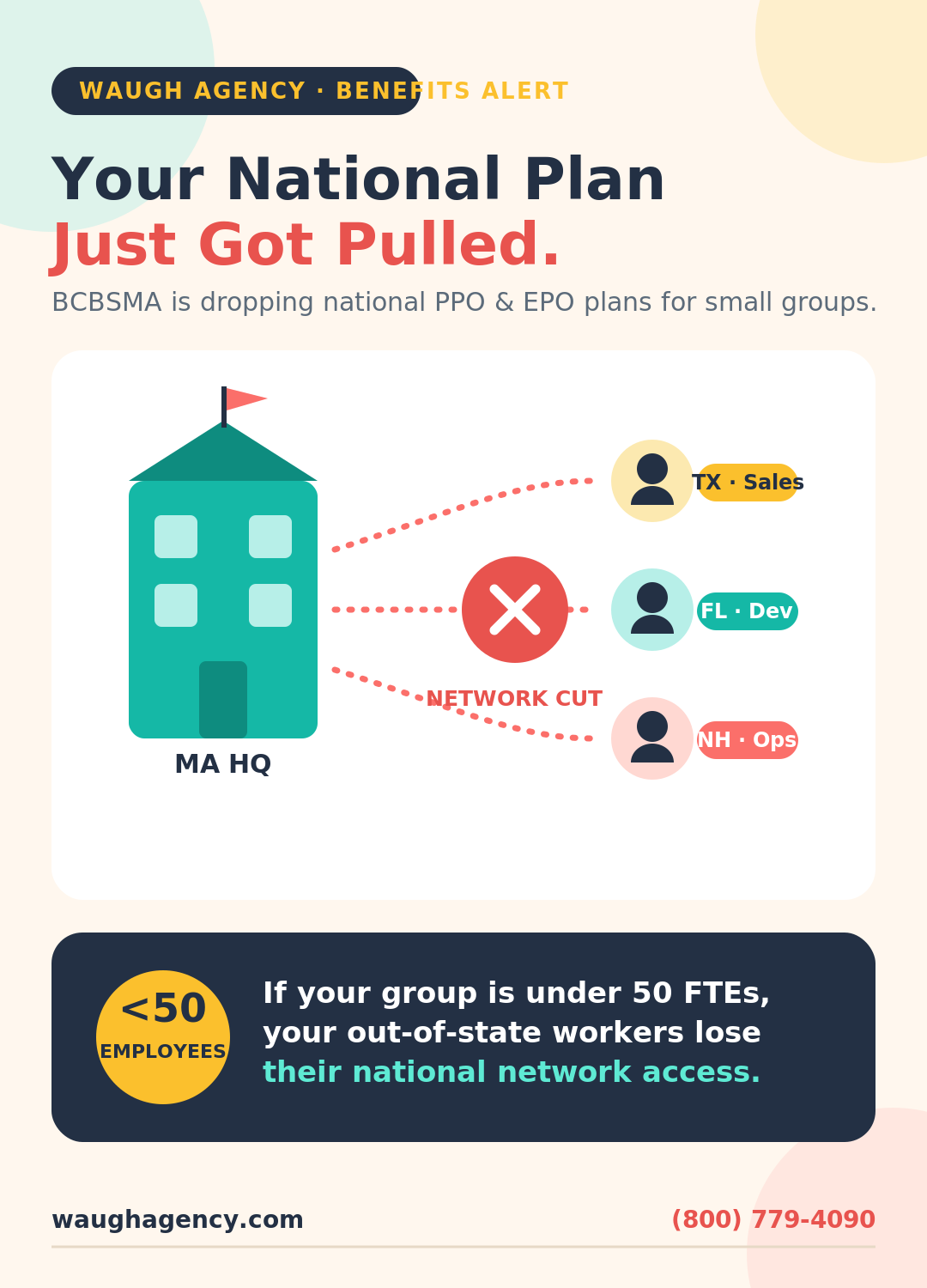
Blue Cross Blue Shield of Massachusetts (BCBSMA) recently announced that, on renewal in 2027, it will no longer offer national PPO or EPO plans to groups with fewer than 50 full-time equivalent employees and to non group individuals.
Complete our quick form for a free consultation, call (800)779-4090 today, or email service@waughagency.com to get started.
In plain English: if you’re a smaller employer and you’ve relied on a BCBSMA plan that gave your out-of-state workers access to a national network, that option is going away when your plan renews in 2027.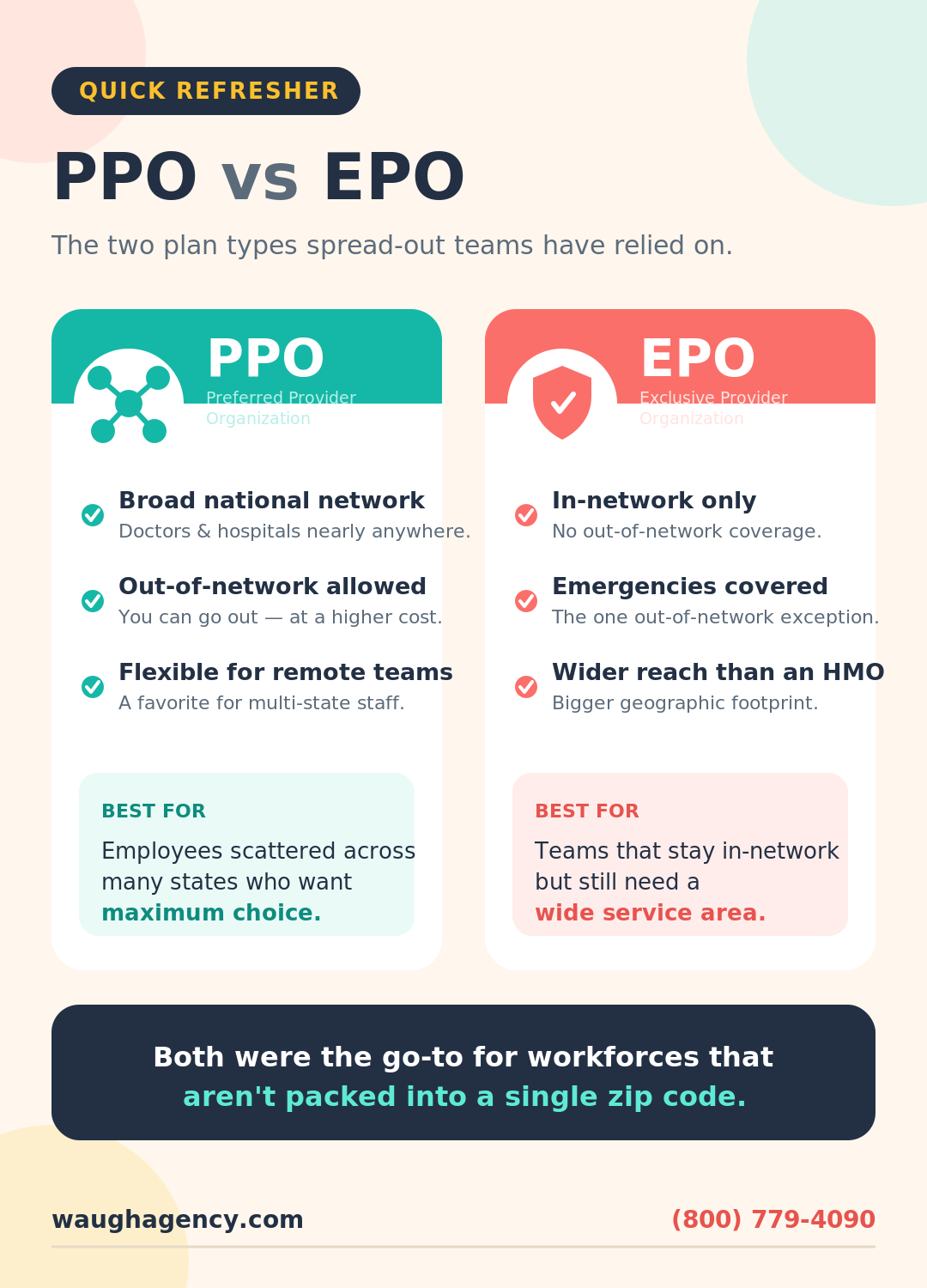
For a Boston-based startup with a sales rep in Texas, a developer in Florida, and a few remote hires scattered across the Northeast, this is a real problem. Local Massachusetts plans work well for local employees — but they aren’t built to cover staff who live and seek care in other states.
This is a fast-moving change, and waiting until renewal to deal with it can leave your team without workable coverage. Call (800) 779-4090 or email service@waughagency.com to have a Waugh Agency specialist review your group before this affects you.
Why PPO and EPO Network Access Matters
A quick refresher on the terms:
- PPO (Preferred Provider Organization): Broad network, flexibility to see out-of-network providers at a higher cost. Popular with multi-state and remote teams.
- EPO (Exclusive Provider Organization): A network-based plan with no out-of-network coverage except emergencies — but often with a wider geographic footprint than an HMO.
Both have historically been the go-to for employers whose workforce isn’t concentrated in one city or state. Losing national versions of these for small groups removes a tool many companies counted on.
Complete our quick form for a free consultation, call (800)779-4090 today, or email service@waughagency.com to get started.
Why Self-Funding Is Suddenly the Smart Move
For years, most small and mid-sized employers steered clear of self-funding. Traditional, fully-insured ACA plans were stable, predictable, and didn’t require health underwriting. Why take on risk?
That math is changing. With national network options shrinking for small groups, modern self-funded arrangements have stepped up to offer exactly what fully-insured carriers are pulling back: flexibility, multi-state coverage, and meaningful cost control.
These aren’t the self-funded plans of a decade ago. Today’s level-funded and innovative self-funded programs come with stop-loss protection that caps your downside, predictable monthly payments, and the chance to get money back when claims run low.
What Modern Self-Funded Plans Can Do That Traditional Plans Can’t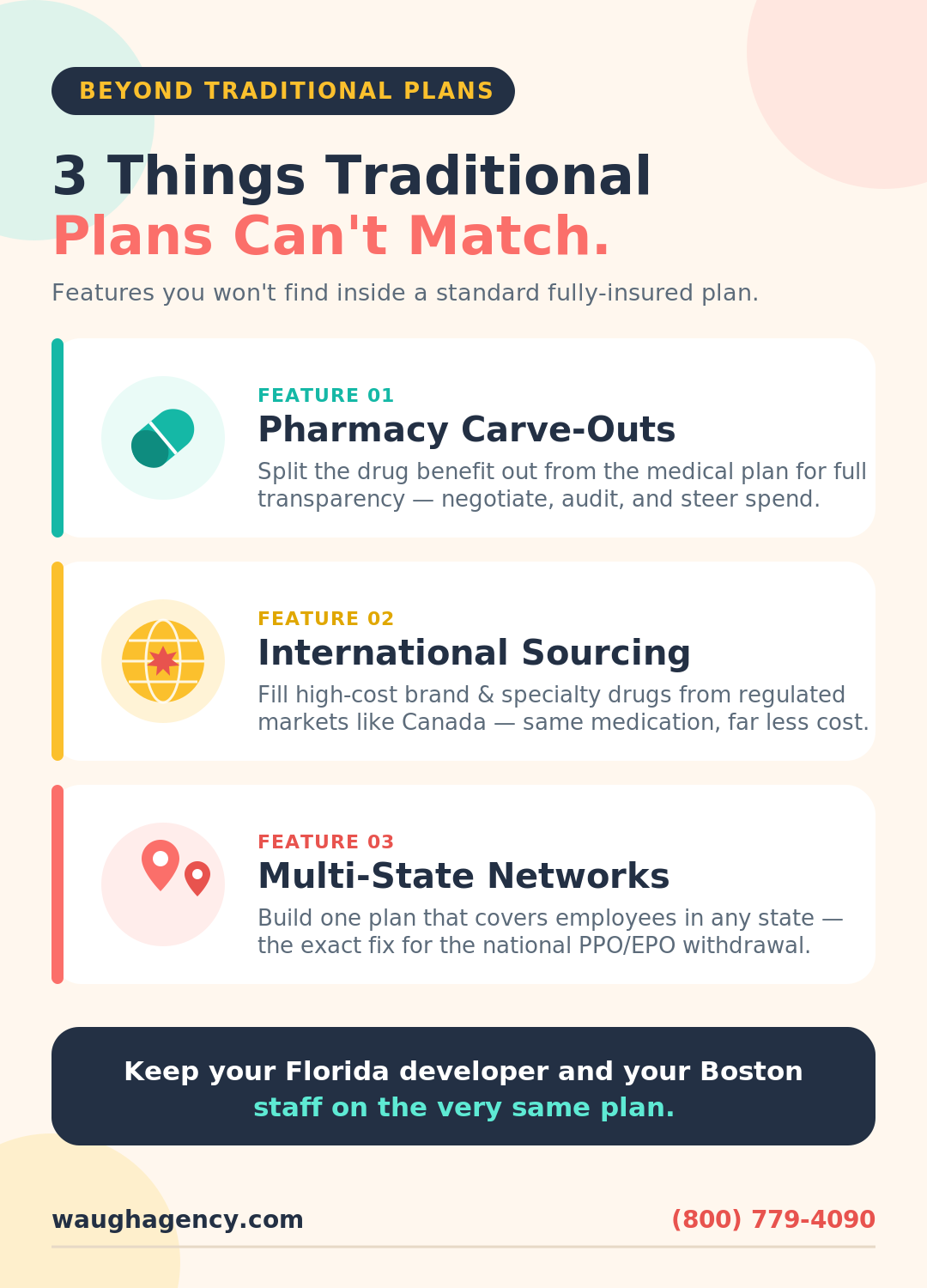
Here’s where it gets interesting. The newer self-funded carriers we work with offer features that simply don’t exist inside a standard fully-insured product.
Pharmacy Carve-Outs
Prescription drugs are one of the fastest-growing pieces of any health plan’s cost. A pharmacy carve-out separates your drug benefit from the medical plan, giving you (and us) far more transparency and control over what you’re actually paying.
Instead of accepting whatever pricing is bundled into a traditional plan, a carve-out lets you negotiate, audit, and steer spend — which can translate into real savings for the group.
International Sourcing for Prescriptions
Some modern self-funded programs use sourcing from regulated foreign markets, such as Canada, to fill certain high-cost specialty and brand-name medications. Because U.S. drug pricing is often dramatically higher than the same medication abroad, this approach can cut costs significantly without changing the medication itself.
For an employee on an expensive maintenance drug, the difference can be substantial — both for them and for the plan.
Flexible Networks Across State Lines
This is the big one for employers caught by the BCBSMA change. Innovative self-funded plans can be built to cover employees regardless of which state they call home. A self funded health plan solves the exact problem the national PPO/EPO withdrawal creates as PPO and EPO plans are standard offerings by today’s self funded administrators — keeping your Florida developer and your New Hampshire account manager on the same plan as your Easthampton headquarters staff.
Who Should Be Paying Attention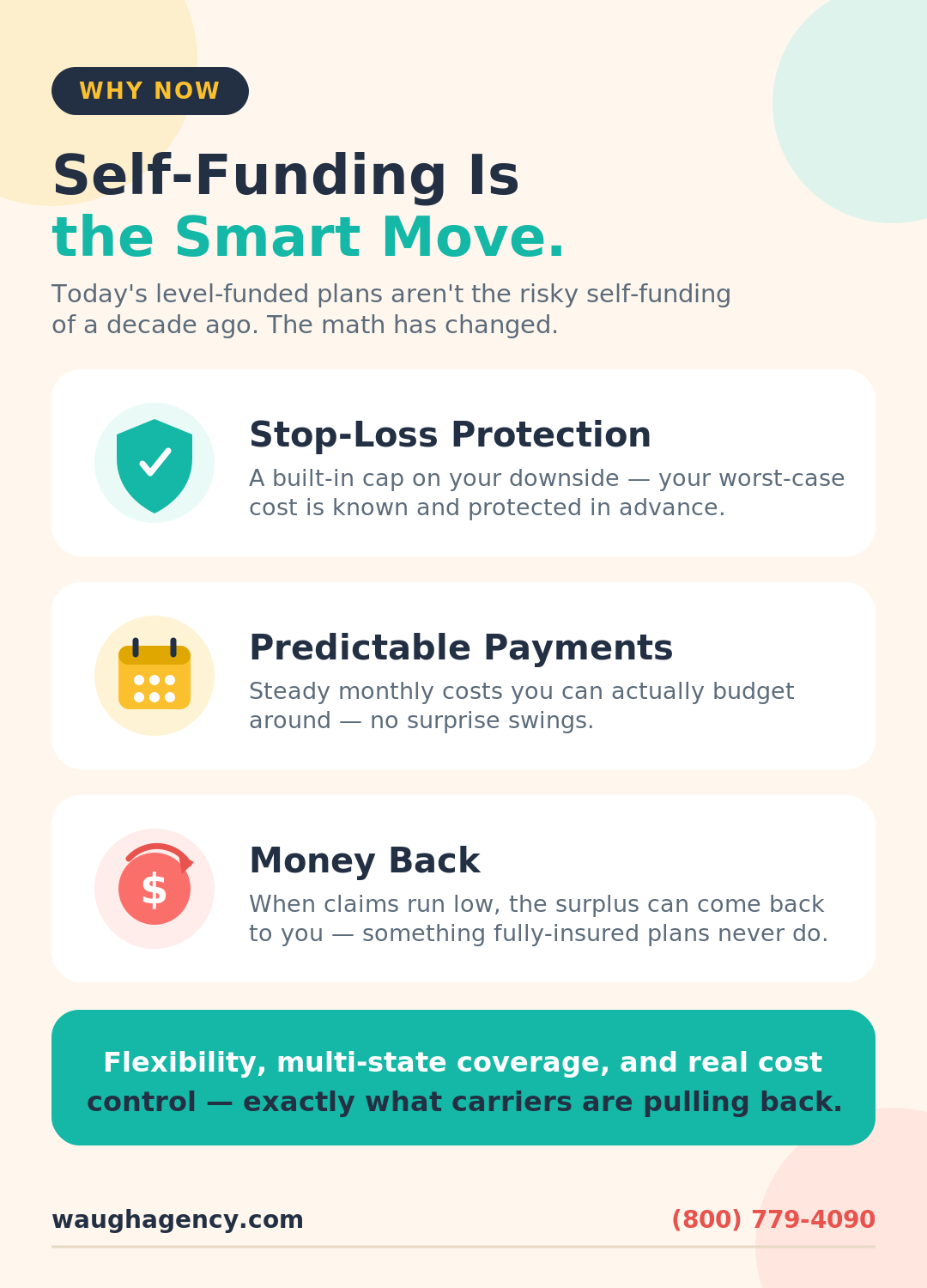
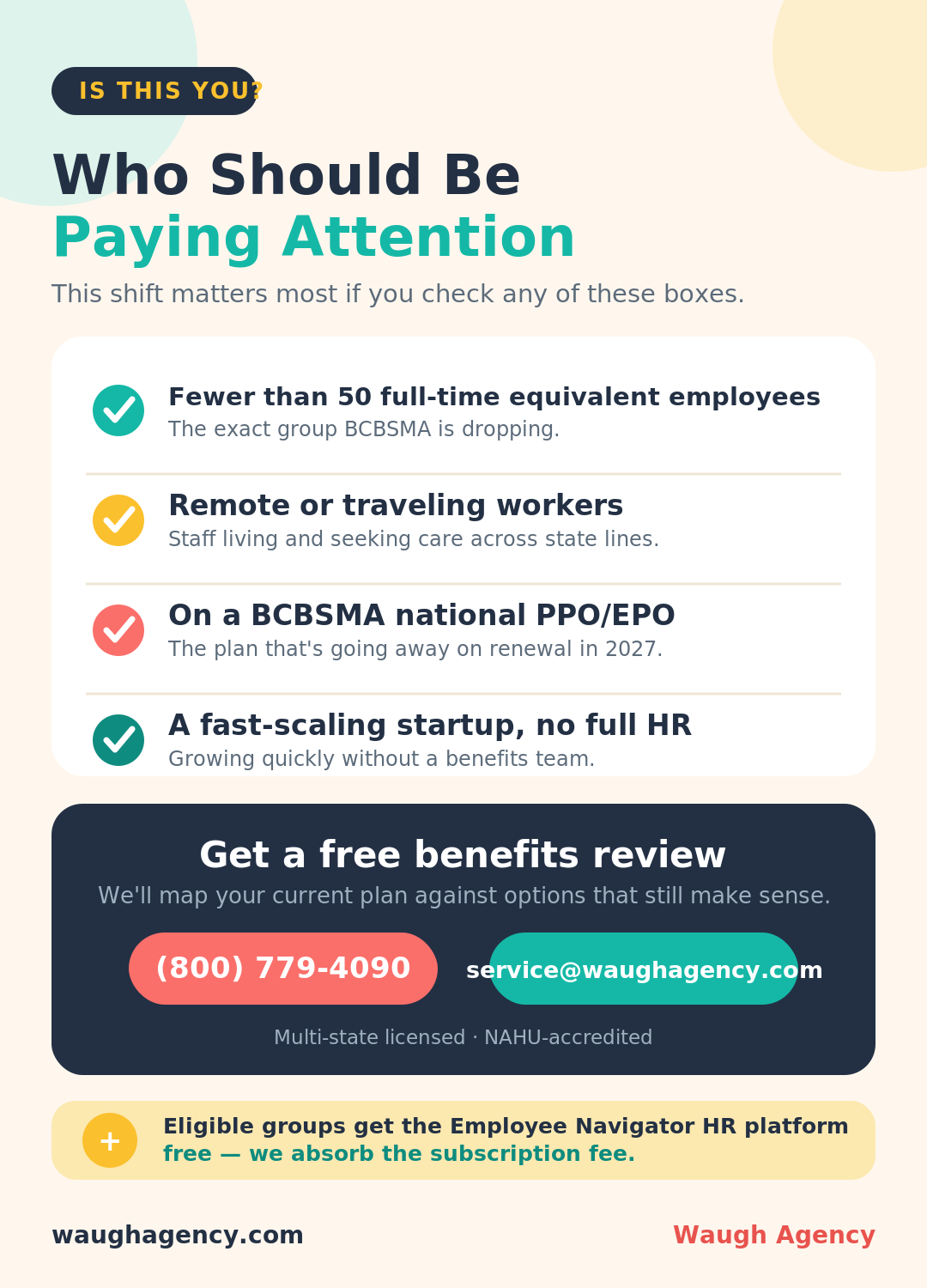
This shift matters most if you:
- Have fewer than 50 full-time equivalent employees
- Employ remote or traveling workers across multiple states
- Currently use a BCBSMA national PPO or EPO plan
- Are a startup or small business scaling quickly without a full HR department
Massachusetts and the broader Northeast — Boston, Worcester, the Cape, Western Mass, plus Connecticut, New Hampshire, Maine, and New York — make up our home turf. But because we serve clients in all 50 states through trusted affiliates, we can build multi-state self-funded solutions no matter where your team lives.
Schedule a free benefits review and we’ll map your current plan against the options that still make sense.
Complete our quick form for a free consultation, call (800)779-4090 today, or email service@waughagency.com to get started.
How Waugh Agency Makes the Transition to a Self Funded Health Plan Painless
Switching funding models sounds intimidating. It doesn’t have to be. As group health and compliance specialists — AHIP-certified, multi-state licensed, and NAHU-accredited — we handle the heavy lifting and keep you compliant along the way.
We also back every transition with technology. Eligible client groups get the Employee Navigator benefits and HR platform at no cost (we absorb the subscription fee).